LAND & PEOPLE · 03

Land is also shaped by memory, livelihoods, and public choices.

I use environmental history and policy writing to understand how people experience changes in land use, agriculture, and energy.

01

INHERITED LANDSCAPES

The Garlic Archive

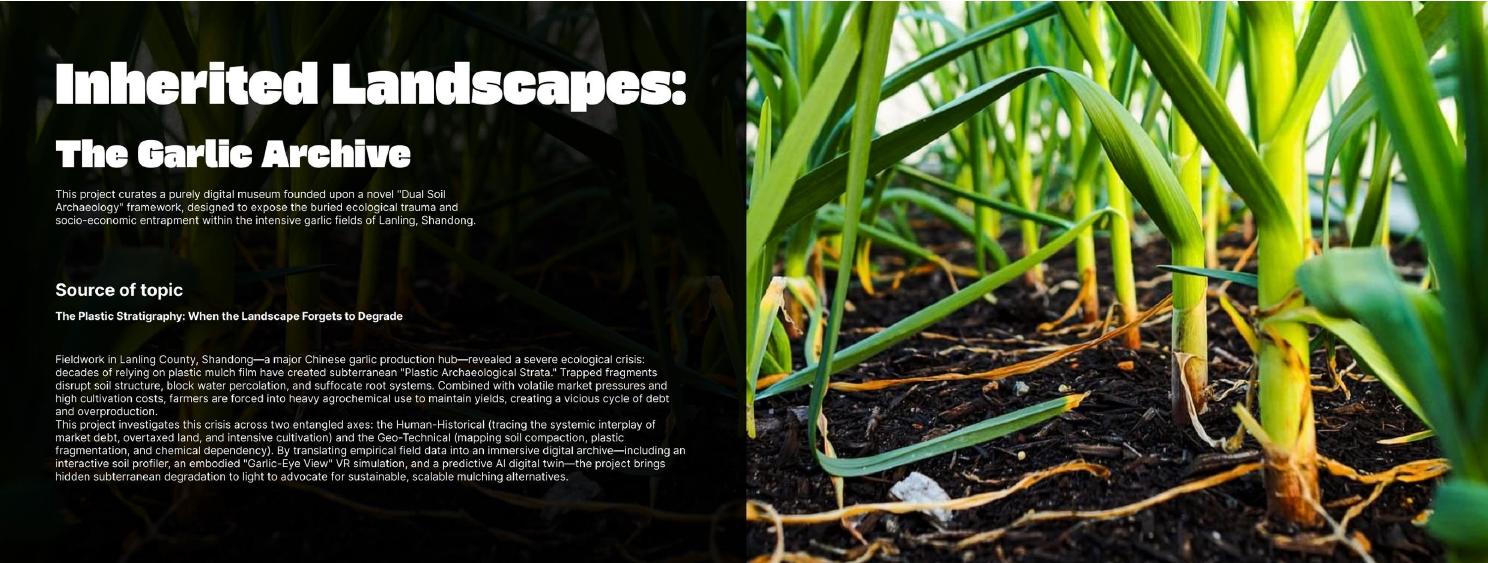
Using "dual soil archaeology" as a framework, I gathered land-use change, plastic-mulch residue, soil compaction, oral histories, and market pressure in the Lanling garlic fields into one digital museum — so that hidden ecological costs become visible.

Enter the Garlic Archive →
The Garlic Archive home screen
The archive opens on the garlic fields themselves, then descends into the soil beneath them.
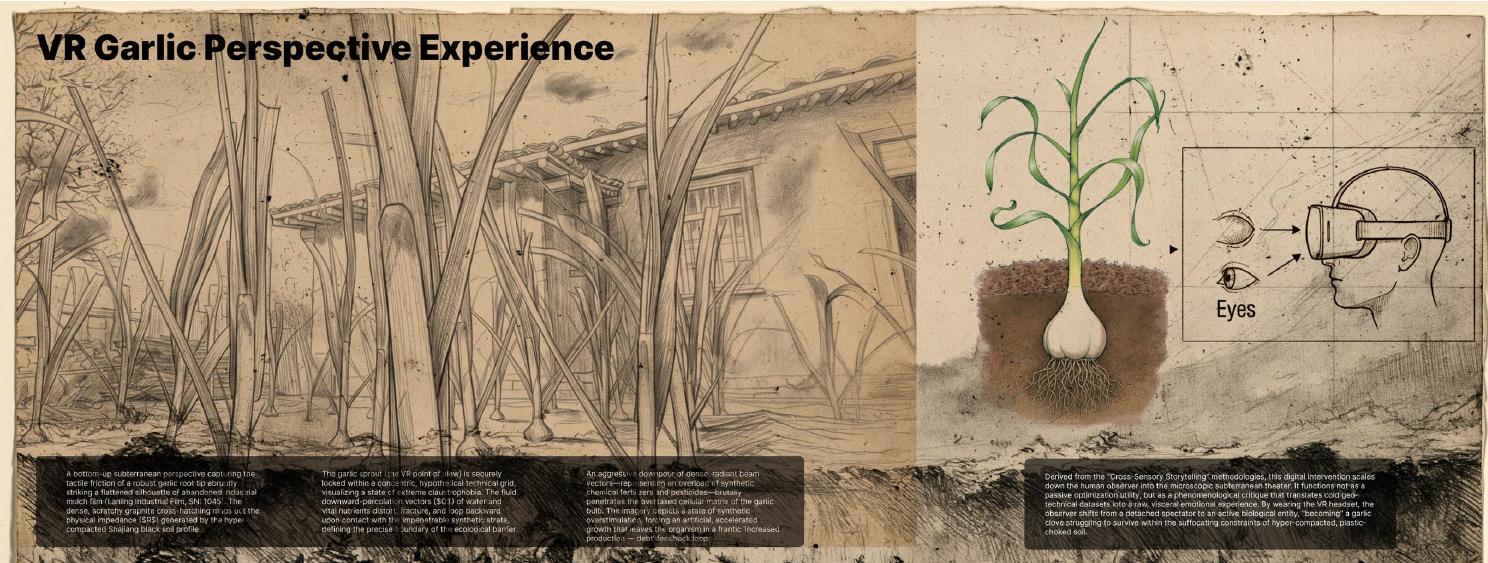
An immersive garlic-root perspective inside the Garlic Archive
A view from beneath the soil, at a garlic root tip: the resistance roots meet from mulch residue and compacted ground.

INSIDE THE ARCHIVE · FOUR CHAPTERS

01

Humanities, History & Archaeology

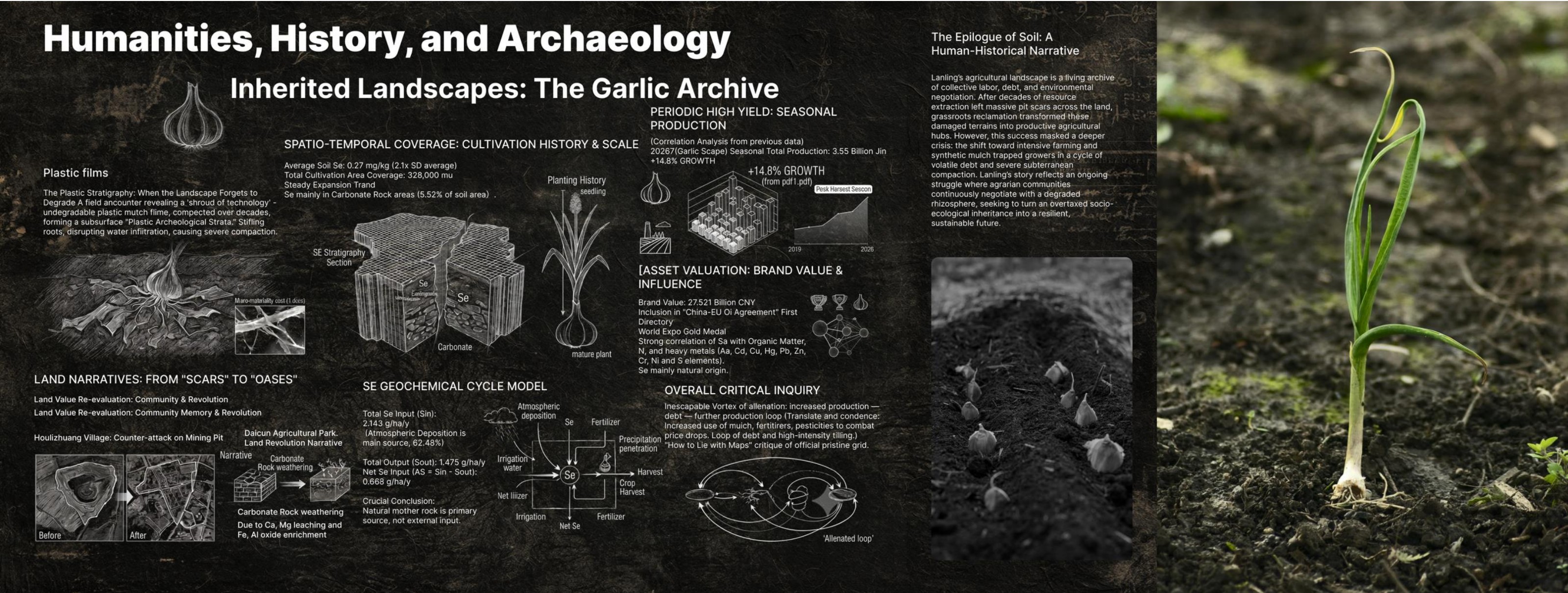
Archive chapter on the agricultural history and land narratives of Lanling
Planting history, cultivation scale, selenium geochemistry, and the land narratives of Houlizhuang and Daicun — set beside the debt and market pressure behind Lanling's record yields.
02

Counter-Mapping: The Map of Erasure

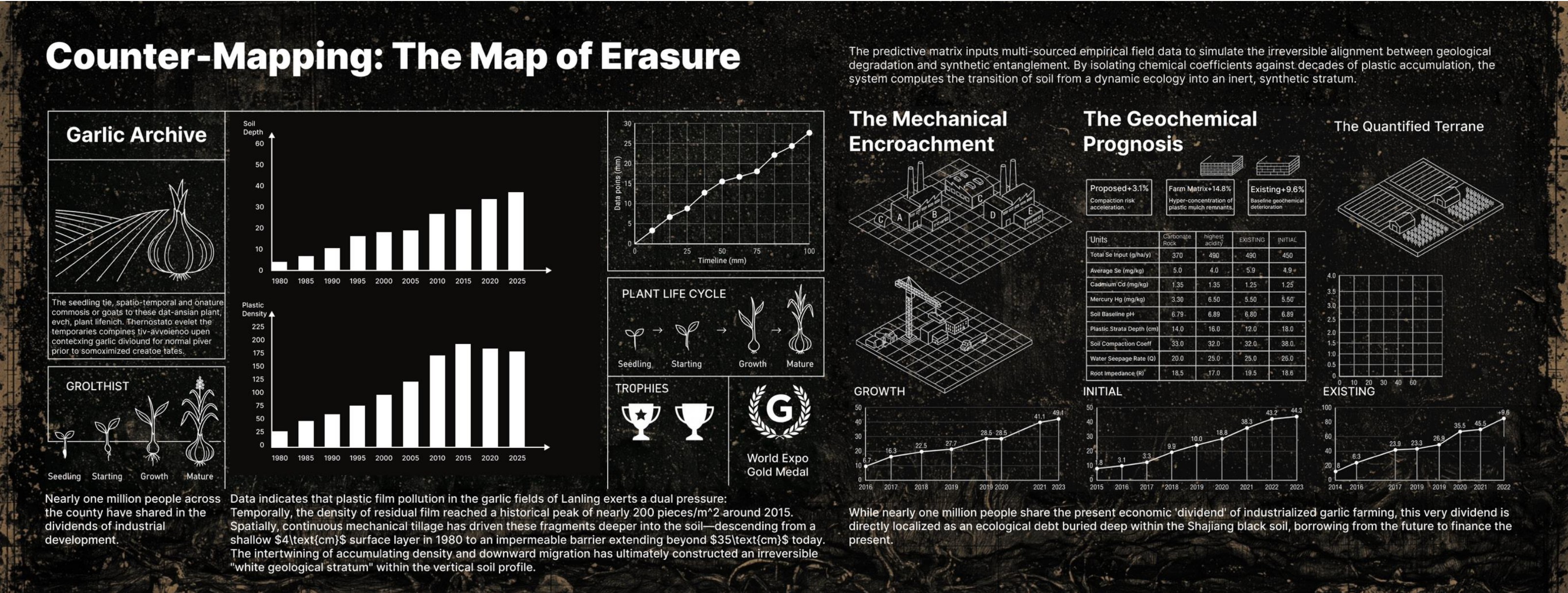
Archive chapter mapping plastic mulch density and downward migration from 1980 to 2025
Mulch density rose to nearly 200 fragments per square metre around 2015, and tillage drove those fragments from a 4 cm surface layer down past 35 cm — an impermeable 'white stratum' mapped across 1980–2025.
03

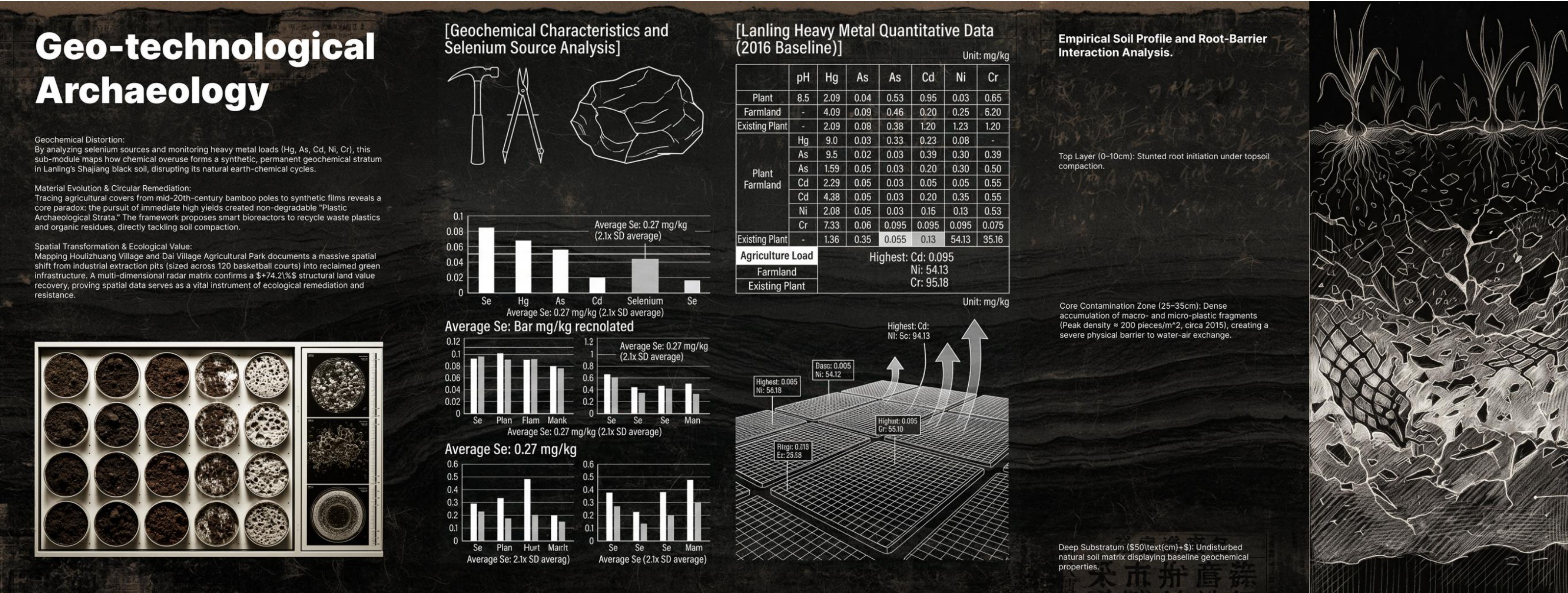
Geo-technological Archaeology

Archive chapter on soil profiles, heavy metals, and root barriers
Heavy-metal baselines (Hg, As, Cd, Ni, Cr) and soil-profile models show how compaction at 0–10 cm, a plastic contamination zone at 25–35 cm, and undisturbed substrate below shape root growth and water exchange.
04

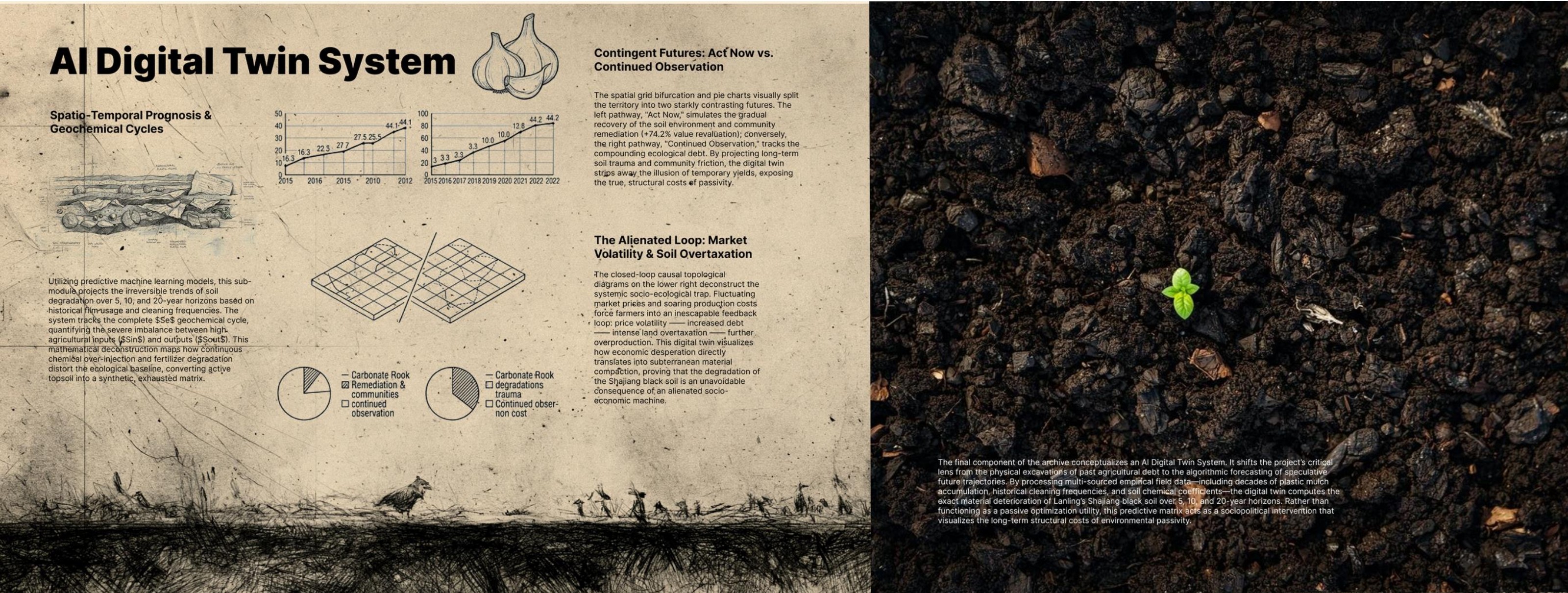
The AI Digital Twin System

Archive chapter on the AI digital twin and future soil scenarios
A predictive model projects soil change over 5, 10, and 20 years, contrasting 'act now' remediation with continued observation, and traces the loop between price volatility, debt, and land overtaxation.
02

What discount rate should long-term environmental policies use?

Re-evaluating welfare based solely on GDP, introducing natural capital, and discussing how declining discount rates address long-term environmental loss. John Locke Public Policy shortlist.

Read project notes →
03

Rural Clean Heating & Energy Equity

Using villager interviews to map the subsidy and maintenance burdens after coal-to-gas and coal-to-electricity transitions, proposing stratified support.

Read project notes →
04

Emerging Contaminants & Waste Battery Recycling

Surveyed 50+ experts and residents across four provinces to draft proposals on risk monitoring, data sharing, traceability, resource recovery, and public education.

Read project notes →
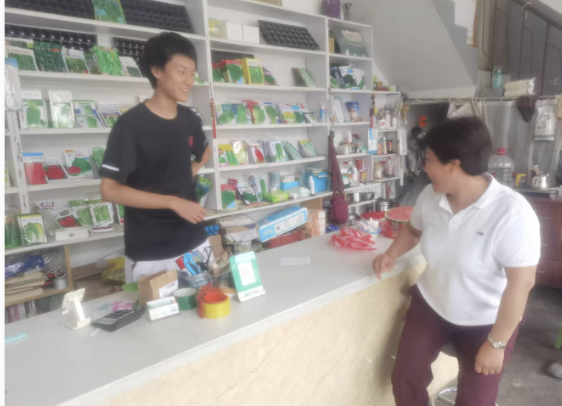
Daniel interviewing an agricultural supply store owner in Lanling

"Evidence lies not only in data, but also in the narratives of how a family farms, how a store advises on chemicals, and how a village bears the costs of policy."